The 28-day cycle myth: what 600,000 real cycles show
In short
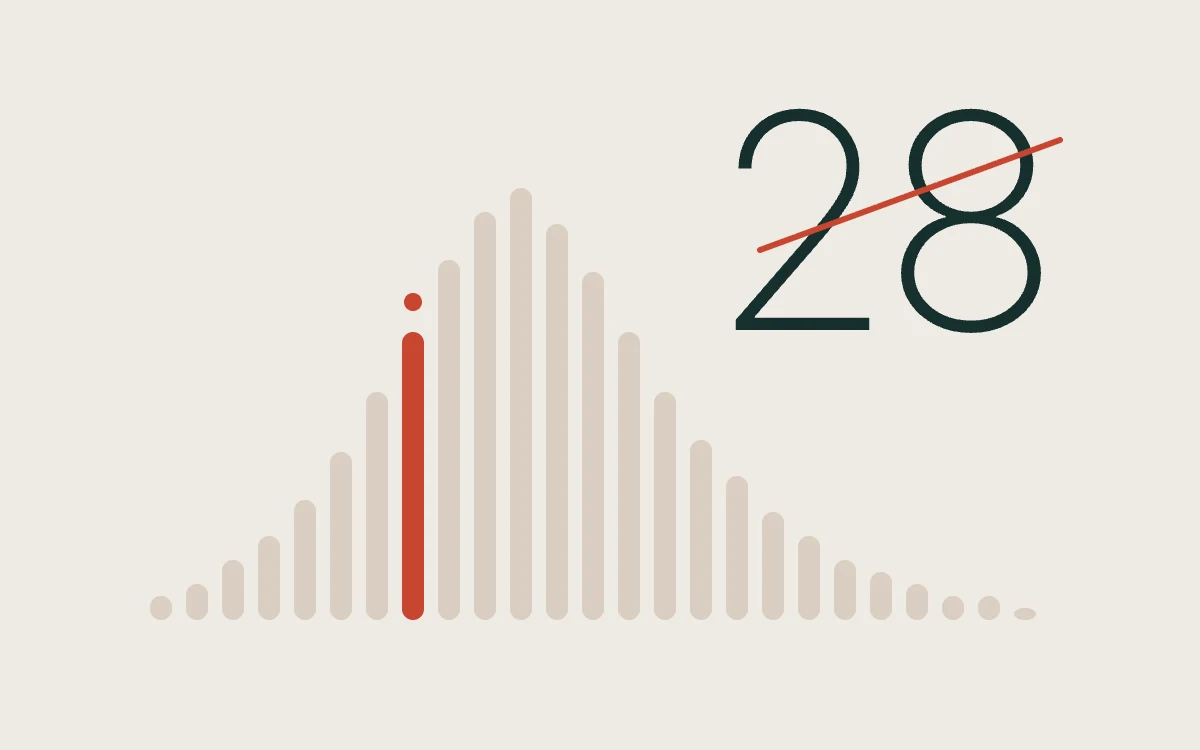
- Only 13% of cycles last exactly 28 days; the average is 29.3
- The first half of the cycle varies a lot; the second stays close to 12 days
- So ovulation is better counted back from your next period than placed on day 14
Textbooks, apps and articles tend to draw the cycle the same way: 28 days, ovulation on day 14. It's a tidy diagram — and real cycles rarely look like it. In 2019 researchers tested this against an enormous dataset, and the numbers surprised even clinicians.
What was studied
A team from University College London and Natural Cycles analysed 612,613 cycles from almost 125,000 women. They all used an app that tracks morning body temperature, so the data shows not just when periods started but roughly when ovulation happened.
The paper, published in npj Digital Medicine, is one of the largest studies of real-world cycles. Two caveats are worth keeping in mind: Natural Cycles funded the research, and the data comes from one app's users, mostly in Europe.
What they found
The average cycle was 29.3 days. But average doesn't mean typical: only 13% of cycles were exactly 28 days. Most were shorter or longer — and that's normal.
The first half varies; the second doesn't. A cycle has two parts:
- the follicular phase, from the start of your period to ovulation — about 17 days on average, and the part that changes the most, between people and from cycle to cycle;
- the luteal phase, from ovulation to your next period — much steadier, about 12 days on average.
The practical takeaway: when a cycle runs long or short, the first phase is almost always the reason, and ovulation moves with it.
Cycles get shorter with age. Between 25 and 45, average cycle length fell by roughly 0.18 days per year, mostly because the first phase got shorter.
Why "ovulation on day 14" doesn't work
The day-14 rule only holds for a cycle of exactly 28 days with a luteal phase of exactly 14. We now know 28-day cycles are the minority, and the second phase is usually shorter than 14 days.
If your cycle is 33 days and your luteal phase is 12, you'll ovulate around day 21, not day 14. A calendar that pins ovulation to day 14 will be a week off.
It's more reliable to count backwards: take your expected next period and subtract the length of your luteal phase. That phase changes little for the same person, and your own history tells you your cycle length.
What counts as a normal cycle
In 2018 FIGO described normal cycles like this:
- frequency: 24 to 38 days;
- regularity: the gap between your shortest and longest cycle over a year is up to 7–9 days, depending on age;
- duration of bleeding: up to 8 days.
Notice that "28" isn't on the list. There's a range — and your own consistency within it.
What this means for you
- Stop measuring yourself against 28. A 26- or 32-day cycle is perfectly ordinary.
- Your history beats any average. The more cycles you log, the clearer your own rhythm and its variation become.
- A forecast should be a window, not a date. "Your period will most likely start December 9–11" is more honest than a single day.
That's how Aya works: it uses the length of your past cycles, accounts for how much they vary, and shows you a window. It counts ovulation back from your next period using your luteal phase — and if you log temperature, it refines the estimate from the rise. You can try the idea in the period calculator, no sign-up needed.
When to see a doctor
Talk to a gynecologist if:
- your cycle is usually shorter than 24 or longer than 38 days;
- your cycle length varies by more than 7–9 days;
- you've had no period for 90 days or more and you're not pregnant;
- bleeding lasts longer than 8 days or has become noticeably heavier.
Limitations of the study
- Data from a single app, mostly European users.
- Ovulation was estimated from temperature, not ultrasound or hormone tests.
- Women using hormonal contraception weren't included.
- The study was funded by the company whose app was analysed.
This article summarises research. It is not medical advice or a method of contraception. If anything about your cycle worries you, see a doctor.
Questions
Is a 25- or 31-day cycle abnormal?
No. FIGO, the international federation of gynecologists, defines a normal cycle frequency as 24 to 38 days. How consistent your cycle is matters more than hitting 28.
Does ovulation always happen on day 14?
No. In the study of 600,000 cycles, most women ovulated on other days. The timing shifts mainly with the first half of the cycle, which differs from person to person.
Can I use a calendar to find 'safe days'?
No. A calendar forecast helps you plan your life; it is not a method of contraception.
Sources
Bull J. R. et al. Real-world menstrual cycle characteristics of more than 600,000 menstrual cycles. npj Digital Medicine, 2019doi.org/10.1038/s41746-019-0152-7The same study on PubMedpubmed.ncbi.nlm.nih.gov/31482137/Munro M. G. et al. The two FIGO systems for normal and abnormal uterine bleeding symptoms: 2018 revisions. Int J Gynaecol Obstet, 2018doi.org/10.1002/ijgo.12666This article summarises research. It is not medical advice or a method of contraception. If in doubt, see a doctor.