How accurate are period tracking apps? What the research says
In short
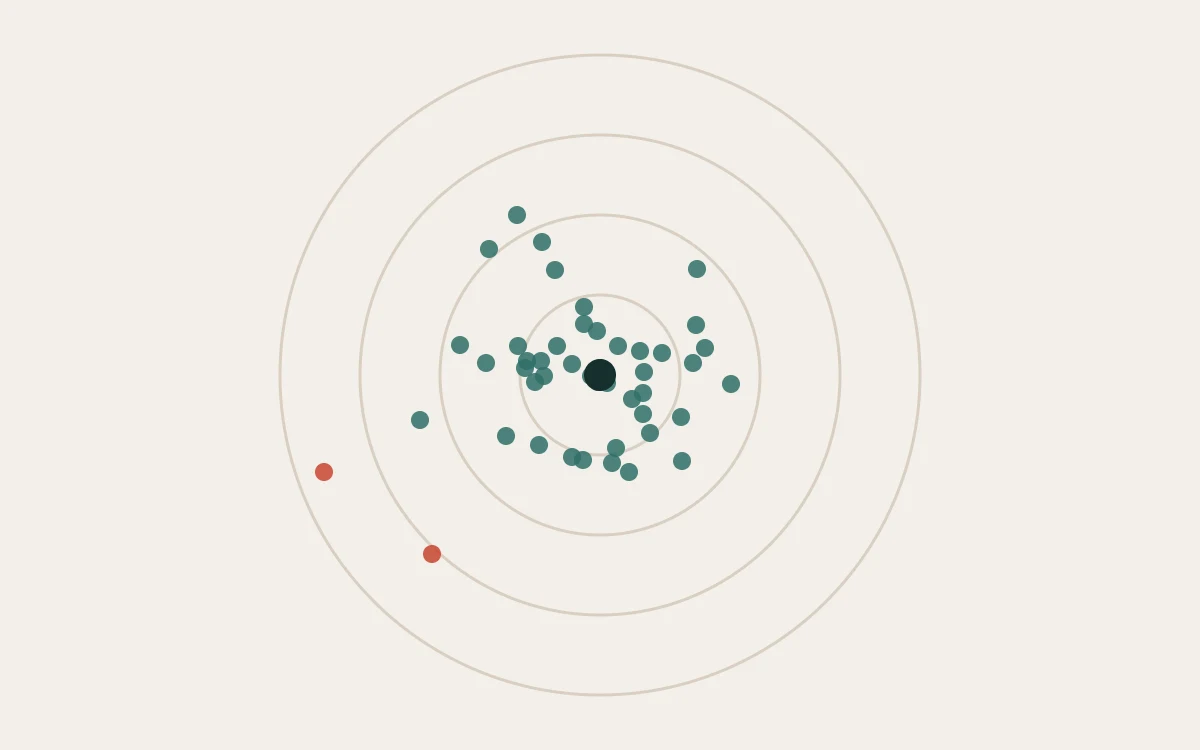
- When 20 websites and 33 apps were given the same cycle, only 1 website and 3 apps got the fertile window exactly right
- Cycle length alone can't predict ovulation day: within cycles of the same length, it falls on different days
- An honest forecast is a window with a margin that narrows as your own data builds up
Your app says, with confidence: "Ovulation — November 14." It's neat, specific, easy to plan around. But how far can you trust it? Researchers have checked — and the results are worth knowing if you rely on a tracker.
What was tested
Test 1: same cycle, different answers. In 2016, researchers in New York entered the same hypothetical cycle — 28 days long, a 4-day period, starting January 1 — into 20 websites and 33 apps. They compared each tool's fertile window with the window considered correct based on the science.
The result: only 1 website and 3 apps predicted the fertile window exactly. Most did include ovulation day, but the windows varied enormously — one app showed 12 "fertile" days, others just 4. The authors called the predictions generally inaccurate and noted that the study couldn't show how this affects the chance of conceiving.
Test 2: calendars versus real ovulation. In 2018, researchers compared calendar methods and apps against ovulation confirmed by urine hormone tests in 949 women. Even in cycles of exactly 28 days, ovulation fell on different days: day 16 was the most common — and only in 21% of cases. The authors concluded that ovulation day can't be predicted accurately from cycle length alone. Worth noting: the study was funded by a maker of ovulation tests, and it looked at one cycle per woman.
Why calendar forecasts miss
It isn't bad programming. It's biology.
- Cycles vary. In a study of more than 600,000 real cycles, only 13% lasted exactly 28 days.
- The first phase moves. The time before ovulation varies from cycle to cycle far more than the time after it (about 12 days). So even cycles of the same length can have ovulation on different days.
- The fertile window is short. A classic 1995 study found that virtually all pregnancies followed sex during a six-day window ending on the day of ovulation. Being 3–4 days off means a different window altogether.
How to spot an honest forecast
Signs of an app that doesn't overpromise:
- it shows a window, not a single date — and the window is wider when data is limited or your cycle is irregular;
- it uses your own history, not just a "28-day norm";
- it refines ovulation from signs — temperature, LH tests, mucus — if you log them;
- it tells you how confident it is;
- it says plainly that it isn't contraception.
An app that names your ovulation day to the day after one or two cycles is giving you a tidy number, not knowledge.
What this means for you
A tracker is useful as a diary and a guide. To make that guide more accurate:
- Log your periods consistently — a few cycles of history beat the cleverest formula.
- If ovulation timing matters to you, add signs: basal body temperature or LH tests.
- Look at the window, not the date.
That's how Aya's forecast works. It uses the length of your past cycles and how much they vary, shows a window and tells you how accurate the forecast is. It counts ovulation back from your next period using your luteal phase — and if you log temperature, it confirms ovulation from the rise and recalculates your next period. Try the approach in the ovulation calculator.
Limitations
- The 2016 study is several years old: apps have been updated since, but the underlying principle — a calendar based on cycle length — hasn't changed.
- The 2018 study looked at one cycle per woman and was funded by a test manufacturer.
- Neither study measured how inaccuracy affects the chance of getting pregnant.
This article summarises research. It is not medical advice or a method of contraception.
Questions
So are period trackers useless?
No. They're great for seeing your period rhythm and noticing changes. The mistake is treating a calendar-based ovulation estimate as a precise fact.
What makes a forecast more accurate?
Your own history over several cycles, plus ovulation signs — basal body temperature, LH tests, cervical mucus. With those, an app can refine its forecast instead of guessing from averages.
Can I use an app's forecast as birth control?
No, unless the app is specifically cleared as a contraceptive. A regular calendar forecast isn't suitable for that.
Sources
Setton R., Tierney C., Tsai T. The accuracy of web sites and cellular phone applications in predicting the fertile window. Obstet Gynecol, 2016pubmed.ncbi.nlm.nih.gov/27275788/Johnson S., Marriott L., Zinaman M. Can apps and calendar methods predict ovulation with accuracy? Curr Med Res Opin, 2018doi.org/10.1080/03007995.2018.1475348Bull J. R. et al. Real-world menstrual cycle characteristics of more than 600,000 menstrual cycles. npj Digital Medicine, 2019doi.org/10.1038/s41746-019-0152-7Wilcox A. J., Weinberg C. R., Baird D. D. Timing of sexual intercourse in relation to ovulation. N Engl J Med, 1995doi.org/10.1056/NEJM199512073332301This article summarises research. It is not medical advice or a method of contraception. If in doubt, see a doctor.